History of the WIlbur Cruce Spanish Mission Horse.
WILBUR - CRUCE
ORIGIN – HISTORY
In the late 1980s in Sasabe, Arizona, the last known vestige of Spanish Mission-type horses were the horses of the Wilbur-Cruce family that started with 25 mares, and a stallion bought in 1885 from Juan Sepulveda, a horse trader from Northern Mexico. His horses originated in Northern Sonora in Mexico, the area of Father Kino's missions. This has been a source of high-quality horses since circa 1700.
Original horses were a closed strain except for a single horse used for two years in the 1930's It was a "paint Morgan" from Colorado. It has been reported that the description and location make it more likely that he was some sort of Spanish horse. This stallion was traded for some of the Wilbur-Cruce strain and was turned out on the range. The ruggedness of the range combined with his being the new to the area makes it doubtful that he contributed much, if anything, to the herd.
Wilbur-Cruce Horses were discovered on the ranch in Southern Arizona in 1990, where they had been living for over 113 years. Their origin goes back to the late 1670s, to Mexico at Rancho Dolores, where Father Eusebio Kino, a Jesuit priest, established his headquarters. Kino was responsible for bringing the first livestock to this area and spreading them northward as he established his mission churches.
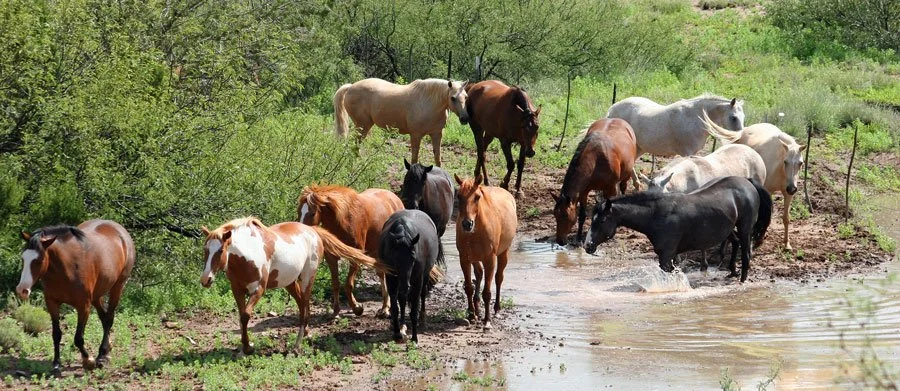
It was Janie Debrott who met Marye and Tom Thompson working with the Cerbat Herd to take a look at these horses that were discovered. I also believe Eva Wilbur-Cruce was there. An excerpt of her words, “Marye Ann and Tom Thompson have driven from Wilcox, AZ to meet us at the Wilbur Ranch to look at what may be the descendants of horses brought out of Mexico in the late 1870's from Padre Kino's headquarters, Mission Dolores established in 1687. Marye Ann is the registrar for the Spanish Mustang Registry, and if anyone can tell us if these horses physically fit the type, she can. After our first glimpse of the horses, we excitedly set off down the boulder strewn mountainside in a barely controlled slide to reach the bottom and to get a closer look. There, grazing before us among thorny Ocotillo cactus and prickly Mesquite trees, was a liver chestnut, Medicine Hat pinto stallion and his two mares; one chestnut and the other a black. Marye Ann's enthusiasm became apparent as she led us from one distantly glimpsed horse band to another until we were caught at dusk with a mountain between us and our trucks parked at the old Wilbur Ranch homestead. Fortunately, it was the Fall season and we were not likely to run into any rattlesnakes in the dark, as they should have been curled up in their burrows, keeping warm. We followed a deeply cut trail back over the mountain, made by thousands of hoof prints. It led us to Arivaca Creek which was, in times of drought, the only available water. It bubbled softly as it flowed beside the old adobe walls of the abandoned Wilbur family home. Back at the vehicles, we recalled what we had seen that day. The list included a band of "dog soldiers", (a term for bachelor stallions), and a wildly colored, flaxen maned and tailed, Overo pinto with a bald face. There was another Medicine Hat stallion, this one a Tobiano pinto with his two mares, one a bay and the other a pinto. We also saw an old, grey stallion with a missing eye, who apparently had lost his mares to a younger, stronger stallion. There were several larger bands with Frame Overos (a large, white rectangle appears on each side of the body), chestnuts, blacks, and bays making up their numbers; some who viewed the world through a blue eye. Could it be that we have discovered a remnant strain of Colonial Spanish Horse!” To find horses naturally descended from the original breeding group, or menada, of 25 mares and a stallion bought to the Wilbur Ranch in 1877 from Rancho Dolores, by Father Eusebio Kino 113 years ago. They had indeed retained their Spanish markers. It must have seemed as if those gathered there that day that they had stepped back in time. To see Debrott’s whole statement see the link below.
"The Spanish horses thrived in the desert and were the horses of the day. They were our companions from sunup to sundown, and sometimes into the night, year in and year out. They had speed, stamina, and intelligence, and, strange as it may seem, they had feelings.” --- Eva Wilbur-Cruce, 1987
“The Wilbur-Cruce herd was brought to the attention of breeders of Colonial Spanish horses in 1989 and illustrated an important point when dealing with the Colonial Spanish Horse – critical conservation of the genetic resource of these populations for the organized studbooks to remain open and receptive to inclusion of new pure herds as they are recognized and documented – Eventually new herds will be recognized only rarely – will always contain valuable genetic material for conservation.” --- Spanish Barb Association
“The Wilbur-Cruce horses are more variable in type than the horses in the registries, even though they have a Spanish origin. This is interesting because they are an example of a closed herd that includes some outlier Spanish types that are taller and heavier than the usual Colonial Spanish Horse type. While this does not detract from the importance of the herd, breeders should focus on perpetuating the more distinctive Iberian type in the herd.” --- Spanish Barb Association
LOCATION:
Wilbur-Cruce Ranch, southern Arizona close to Magdalena region of Arizona
HUMANS CONNECTED TO HERD:
Wilber Family and Eva Wilbur-Cruce, whose grandfather founded the Wilbur Ranch.
PARTICULAR CONFORMATION DISTINCTIONS
"....the Wilbur-Cruce horses show the greatest genetic resemblance to "Old Spanish" breeds and North African Barbs. These horses, based upon the analysis I have just done, are probably the best or near best representatives of the old Spanish type that was brought to the New World". --- Dr. Gus Cothran, PhD, Texas A&M Clinical Professor, Veterinary Medicine & Biomedical Sciences, Texas A&M University, College Station, Texas.
COAT COLORS
Coat colors conform to breed standards and uniform breed phenotype.
CURRENT STATUS Disbursed
When Ava Wilbur-Cruce disbursed her Barb herd there were seventy-seven horses, including only seven foals as the others, along with some adult Barbs, had been killed by mountain lions. There were an equal number of mares and stallions. Wilbur-Cruce sold all the Barbs to breeders, even the ‘extra’ stallions. The Brislawn family disbursed their herd similarly. The same holds true with Robert and Louise Painter’s herd at the time of his death.
“In 1990, the riparian portion of the Wilbur-Cruce Ranch was sold to the Nature Conservancy. Due to the horses’ genetic importance, Dr. Wilbur’s granddaughter, Eva-Antonia Wilbur-Cruce, donated the direct descendants of the original herd to the American Livestock Breeds Conservancy (ALBC). The Conservancy confirmed that these horses were pure and direct descendants of the original Spanish horses brought to the New World.” --- Returntofreedom.org
Dr Phil Sponenberg wrote the following report for the Livestock Conservancy in 1991:
”An optimistic estimate of the number of pure strains of horses derived from Spanish Colonial days that persevere to this day, would be five strains. Most other strains have long been absorbed into the Quarter Horse breed, (with draft and Thoroughbred influence), or have undergone extinction. The Wilbur-Cruce strain is the only known ”rancher” strain of pure horses that persist in the southwest. The Wilber-Cruce horses are of great interest because they are a non-feral strain. The only other strains of Spanish horses in existence to this day are feral strains in certain isolated areas (Kiger and Cerbat BLM herds currently, although examples of pure horses of other populations now extinct or contaminated, are present in owned, managed herds), and the Choctaw/Cherokee strains which originated in the Southeast. To this very short list can be added the Belsky and Romero/McKinley strains, but neither of these can claim the historic isolation that the Wilbur-Cruce horses have had, and both are somewhat of doubtful purity as to Spanish ancestry. The Wilbur-Cruce horses, as a non-feral strain, are therefore truly unique.
Visual examination of the Wilber-Cruce herd indicates that the herd history is very likely accurate. The horses are remarkably uniform, and of a very pronounced Spanish phenotype, In some instances this is an extreme Spanish type, such as is rare in other Spanish strains persisting in North America. This type is illustrated in paintings of Spanish horses during the colonial period, and it was a pleasant though great surprise to see it persisting to this day. The horses varied over a very narrow range from this extreme type to a more moderate type that is more common in other North American strains and Iberian strains today.
The need to conserve this herd is great, since they do represent a unique genetic resource. The Food and Agriculture Organization of the United Nations has become interested in rare breed conservation over the last fifteen years, and their interest in horses is limited to those breeds that are uninfluenced by the Arabian and the Thoroughbred. The reason they have limited their interest and energy to horses without such influence is the incredible scarcity of such populations worldwide. The Wilbur-Cruce horses fit in this category very securely, and are therefore of great interest and importance, not only in North America, but in the worldwide efforts to conserve genetically unique populations of livestock.
The American Minor Breeds Conservancy is very interested in this population. It must be emphasized that this interest is very great in the case of the Wilbur-Cruce horses, and very limited with regard to most other horse types. For example, the AMBC has no interest in the conservation of western feral populations except for the few (two) of purely Spanish phenotype. The Wilbur-Cruce population is a most significant discovery of a type of horse thought to be gone forever.” --- Dr Phil Sponenberg
“The American Minor Breeds Conservancy was recently fortunate to have been able to directly intervene and conserve a unique herd of horses.
The Wilbur-Cruce Mission herd (Mission refers to their origin), was located on the Wibur-Cruce Ranch near Arivaca, Arizona. This ranch had been in the ownership of one family since the late 1870s. The horses on the ranch had been bred by three generations of the ranch family, (originally Wilbur, but now Wilbur-Cruce by marriage). Eva Wilbur-Cruce, the present and elderly owner, states that the herd began with the purchase of 25 mares and a stallion from Juan Sepulveda in 1885, who gathered the horses from Father Eusebio Kino's Rancho Dolores area. Mission Dolores and Rancho Dolores were established by Kino not long after his arrival in the Pimeria Alta, the area made up of southern Arizona and northern Sonora during the late 1600s hundreds and early 1700 hundreds. Kino was essential in establishing the production of livestock in the Pimeria Alta. He brought in good quality stock of various species and was responsible for the establishment of the mission chain in the Pimeria Alta. Because of this background, interest was increased in the horses, for we do not know how many of this sort of horse survive in Mexico.
*Editor’s Note: The Wilbur family’s oral tradition concerning the horses was corroborated in 2019, when Rene Celaya, the great grandson of Guadalupe Sepulveda, attended a promotional event for the Wilbur-Cruce Mission horses. He confirmed the story of his great-grandfather sending large herds of horses driven by his son, Juan, from his Rancho to be sold. Rene verified that these horses were descendants of Kino's horses.
No other horses had been added to the herd with the exception of a single stallion, reportedly a “paint Morgan” from Colorado that ran with the herd for two years in the 1930’s. This history is interesting, since these horses were very likely to be purely Spanish mission/ranch stock from the Southwest. Such stock is very rare, even in the Spanish Mustang Registry and Southwest Spanish Mustang Registry, which cover pure Spanish stock. As to the “paint Morgan,” who could have had some effect on the herd, but was unlikely to be the same as Morgans today, (color alone would rule that out) and was likely Spanish himself. The terrain is very rugged on the ranch, and he could only have had minimal impact on the herd at any rate having not been raised there and adapted to the environment.
The land on which the horses ranged varies from steep, rocky terrain with Mesquite trees and cactus such as Ocotillo to Cottonwood/ Riparian Woodland along Arivaca Creek. This land was adjacent to the Buenos Aires Wildlife Refuge, and Mrs. Wilbur-Cruce was selling the land to the Nature Conservancy to be added to the Refuge. The Refuge has a specific mandate to reintroduce the endangered Masked Bobwhite Quail. Since the Refuge has no such mandate for horses, they had to be removed.
Fortunately, the mustang grapevine found out about these horses through Marye Ann Thompson, a long time conservation breeder of Spanish Mustangs. Steve Dobrott, employed by the Refuge as a wildlife biologist, contacted Mary Ann (registrar of the Spanish Mustang Registry), because he had read Eva Wilbur-Cruce’s book, A Beautiful, Cruel Country. In it Eva tells the story of the family’s “little rock horses” and this made him curious to know if the current horses on the ranch could be Spanish in origin. That is how I became aware of them and their history. This really is the first important lesson in the rescue: each breed and each species benefits from a network of interested people that keep their ears and eyes open. This is the best way to turn up leads of new populations, or herds about to be dispersed. This informed network is one of the very important functions of AMBC, and keeps rare or unusual herds and flocks from disappearing without a trace, and without anyone’s knowledge that something unique has been lost.
Mary Ann Thompson was the specific part of the grapevine that informed me of the horses. She is essential in the conservation of a very unique horse strain based on feral horses from the Marble Canyon of the Cerbat Mountains in Arizona. I had not seen her in years, so I decided, at the bribe of wild horses and hot food, to go out in January and evaluate the Wilbur-Cruce herd with her. We also had an opportunity to evaluate some horses recently captured from the Marble Canyon area, which was an added bonus.
We evaluated what horses we could find. The herd was estimated at between 75 to 100, and we certainly saw 60 or so in one day. A drought had begun, and the lack of water forced the horses to use a few waterholes along the creek. One of those had been dug out of the sand by the horses. This concentrated the horses for easy viewing. It is amazing, in the mountains, to witness how quickly horses can disappear. This first inspection was a critical part of the assessment, for it allowed us to determine if the history made sense, based on appearance.
The horses did indeed look pure Spanish, except for two, very tame, tattooed, racing, Quarter Horse mares that obviously were not a part of the ranch population. As had been observed by those who made a census of the herd when they were still at the ranch, the mares were unable to join the herd because they had not developed locally and been adapted to the extremely steep, rocky terrain. We were curious about these, but figured it would be easy to sort through and remove from the breeding population.* The horses were about 14 to 15 hands, slightly larger than many wild strains. They had various shades of chestnut, bay, black, and grey, with some Tobiano, Overo, and Sabino paints. These were very interesting and indeed popular in the local area as using horses in the mountains. Recent captures made to reduce the size of the herd, had removed many pintos and all the Grullos, Duns and Palominos, as they were seen as easy to sell. The lesson here is that conservation breeders need to watch the rare variants to assure that they persist in the population.
*Editor’s Note: It was later discovered the mares had been stolen by their owner’s neighbor because they so frequently trespassed on his property. The neighbor chose the unoccupied Wilbur Ranch as a good spot to hide the mares.
At this point the main lesson was to hurry up and wait. The horses were to be removed by June, but we were hoping that a reversal of policy would be possible and the horses could remain as a managed herd on the refuge. We did negotiate the donation of the horses, by Mrs. Wilbur-Cruce to the AMBC, in order to more effectively monitor their status. At this point Mrs. Wilbur-Cruce had a stroke, and we were in fact lucky to have timed the donation when we did, so that the horses could be saved. She is now largely recovered from the stroke, but the stroke does serve to illustrate how precariously perched are those populations in the hands of elderly breeders without interested, younger generations.
The drought continued into the late spring, which had the unfortunate consequence that foals were being killed by mountain lions. This happened to several foals, and indeed some of the adult horses had scars that are consistent with bouts with lions. We also had a few horses stolen off the range. Some of the very interesting individuals were never found. The Arizona State Livestock inspectors must be given full credit for helping effectively with the legal ramifications of the horses, including the stolen ones. They really went out of their way to help, and were essential to the success of the whole operation.
With the drought and a deadline of June, it was decided to remove the horses and place them with interested breeders. Once again, the mustang grapevine worked well, and we had plenty of breeders used to working with range horses and familiar with conservation breeding that wanted these horses. Some people were disappointed in not getting horses, some were critical that it was not more widely publicized. Still, the horses are now in the hands of good breeders, and that was the first priority of the rescue.
Because of the drought, the creek was the only water source, and it was fairly easy to trap the horses at water near the ranch homestead. They were then loaded by using the ranch’s old, mesquite, corral chute into an open topped bob-tailed truck and removed to a defunct feed lot where they were held until all horse had been captured.
This went fairly smoothly under the guidance of Richard Jordan of Benson, Arizona. His work cannot be praised highly enough. The herd numbered 77, including only 7 surviving foals. One half of the herd consisted of stallions and the other half, mares. Very few yearlings were present, because of lion predation. The horses were then taken to a rural area outside of Tucson, Arizona, to an arena and a few pens owned by the “Old Tucson” movie set and amusement park which gave the public some chance to see them.
At that point I went back out to Arizona, in the record-breaking heat of 114 degrees, to sort through the herd and place the animals with the various owners. We placed all the mares with breeders, and enough of the stallions to have a viable population into the future. The goal was to place the horses in such a way that the genetic variability was fairly evenly distributed throughout the breeding groups. Excess stallions were auctioned on a very hot evening. They brought less money than expected, but Mary Ann Thompson, who attended the auction, says that all ended up as using or breeding horses and none went to the meat market. This is amazing given the age and sex of the horses sold.
Blood samples were also taken for blood typing. It became apparent in looking at all the horses captured, that some few were probably not Spanish and the blood typing was the final clue. A few horses were obviously not consistent with a Spanish origin. There were the two quarter horse mares previously mentioned. It is uncertain the extent to which similar escapades had gone on in the past, but this would certainly change the opinion of the purity of the herd. Fortunately, blood typing in horses can help sort through this sort of thing, and Dr. Gus Cothran of Kentucky (now Texas A & M), helped immensely by blood typing this herd. This is a time consuming process. The results of the typing indicate that the history is accurate; these are indeed a unique population with a long history of genetic isolation from other horses. The few outside horses had been introduced so recently as to not have any genetic effect on the herd.
“AMBC has done something very worthwhile in this rescue. Valuable contacts were made with the BLM, wild horse organizations, and others interested in conserving rare sorts of horses. AMBC also learned a great deal about the value of a network of informed and interested people, as well as how to use the network effectively. In the next few years other such rescues may be possible. It is an excellent accomplishment, if AMBC can step up and take imperiled animals for which they can be responsible and then place them with breeders. With that in mind I hope that AMBC can build a rescue fund so that future, such endeavors have a secure base of funding.” --- Dr. Phil Sponenberg PhD, DVM, 1991
Edited and Updated by Jane Dobrott, 2020; Capture Underwritten by The Livestock Conservancy; www.livestockconservancy.org
https://www.spanishbarb.com/_files/ugd/47e6a1_24e58f01e5ed4373859edf54fb06c874.pdf
The Spanish Mustang Foundation ©2022 Connie Doughman

Our process is simple and thoughtful.
Explore our range of services designed to help you move forward with confidence, wherever you're headed next.
In-person and remote options
Our office is conveniently located in Manhattan. A place to gather, grow, and reconnect.
Our Services
Explore our range of services designed to help you move forward with confidence, wherever you're headed next.
Meet the Team
-
![]()
Monet Goode
FOUNDER
With a vision for building something meaningful, our founder brings a blend of big-picture thinking and hands-on experience.
They set the tone for everything we do. -
![]()
Emmett Marsh
SALES MANAGER
Focused, approachable, and driven by results, our sales manager is all about building strong relationships. They help connect people to the right solutions—with clarity and care. -
![]()
Eleanor Parks
MARKETING DIRECTOR
Creative and strategic in equal measure, our marketing director brings fresh ideas to every campaign. They turn insights into action and help our message resonate with the right audience. -
![]()
Karl Holland
CUSTOMER SERVICE MANAGER
Friendly, attentive, and always ready to help, our customer service manager ensures every interaction is a positive one. They keep communication clear, timely, and human.